Georg Baselitz, Phillips

Georg Baselitz

Drop Closed

ABOUT THE DROP

Georg Baselitz, Erica Dadagon

The Project

Alongside legendary French art publisher Cahiers d’Art, Dropshop is honored to release a new edition of Cahiers d'Art Revue dedicated to leading German artist Georg Baselitz. The limited edition monograph features a text by art historian and long-time friend of the artist, Éric Darragon, who explores several of Baselitz's series from 1990-2023 while reflecting on critical responses and the evolution of his art. The text delves into Baselitz's influences, including prominent artists like Duchamp, Matisse, and Picasso, and highlights the political themes present in his earlier communist-inspired works. It also examines Baselitz's journey from East to West.  

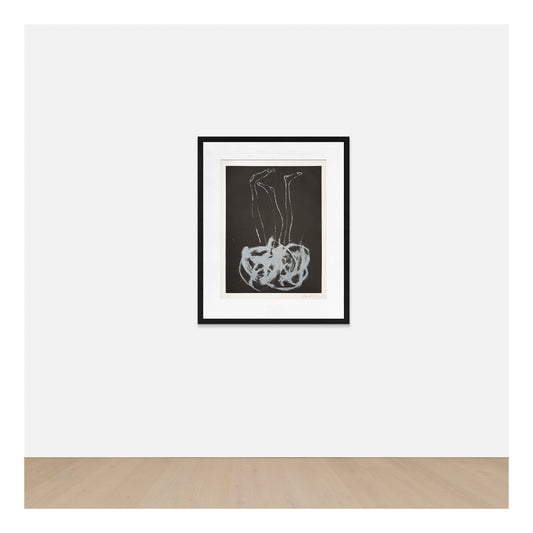
Presented alongside the publication is Baselitz’s 2020 aquatint Erica Dadagon, a work that further reflects the close intellectual exchange between the artist and Darragon. Its title playfully references both the art historian and the Dada movement, whose spirit resonates throughout the work. Created during the global pandemic, the print recalls the satirical and psychologically charged works produced in the aftermath of World War I by artists such as Hannah Höch and George Grosz. 

The imagery within Erica Dadagon also connects to Baselitz’s 2021 solo exhibition Springtime at Gagosian, where the artist introduced collage into his practice for the first time, incorporating nylon stockings into his iconic inverted compositions. In his accompanying essay for the exhibition, Darragon explored the recurring symbolism of stockings throughout art and cinema history, drawing connections between Baselitz and historically significant figures such as Edgar Degas and Egon Schiele. 

Baselitz’s practice is defined by continual reinvention, merging personal memory with a critical reexamination of art history. Together, Erica Dadagon and this newly published edition of Cahiers d’Art Revue capture the restless and evolving spirit that shaped Baselitz’s artistic legacy. 

© Georg Baselitz

Georg Baselitz, Cahiers D'art

The Print & Monograph

Georg Baselitz 
Erica Dadagon, 2020 
Edition of 100 
Medium:  Two-color aquatint on Hahnemühle büitten paper (300g), with full margins. 
Dimensions: 33 3/4 x 24 7/8 in. (85.7 x 63.2 cm) 
Price: $2,000, unframed  

Cahiers d'Art: Georg Baselitz, 2025 
Edition of 100 
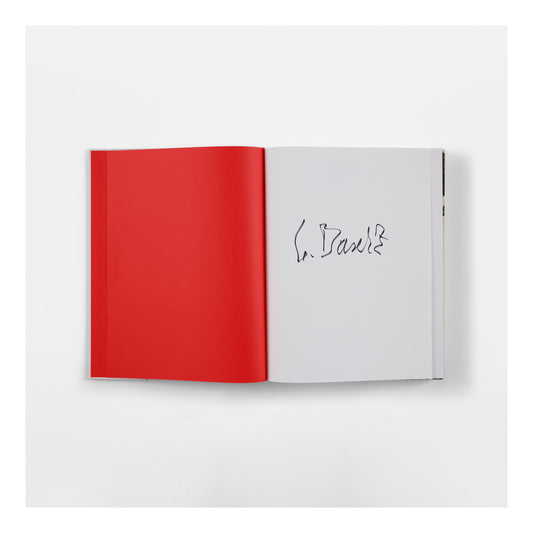
Medium: 272 Page hardcover monograph in the printed cardboard slipcase, each book accompanied by 3 posters folded inside the book (as issued). 
Dimensions: 9 7/8 x 12 1/2 x 1 1/8 in. (25.1 x 31.8 x 2.9 cm) 
Authenticity: Signed by the artist on the flyleaf and numbered on the accompanying certificate of authenticity. 
Price: $1,500  

Clients who purchase both the limited-edition monograph and Erica Dadagon print will receive the pair for a special rate of $3,000. 

In the monograph, Éric Darragon draws connections between Picasso, Baselitz, "and the others," focusing on self-portraiture, the evolution of painting styles, political contexts, and the broader narrative of art history. Baselitz himself references Vasari and the Uffizi, envisioning a dialogue among artists through their portraits. In 2018, his exploration of portraiture culminated with the series "Devotion," in which he represents the artists he admires. These portraits convey a flat world lacking unity, presenting an intriguing mix of genders-where women resemble men, men resemble women, and everyone appears as if they were taken from a family album. This monograph interweaves Baselitz's personal photographs-such as family portraits and Polaroids from his creative process-with his paintings and sculptures created from the 1990s until 2023. It showcases his body of work as a diary where personal and historical narratives intersect, illustrating how his art has evolved over the decades. This evolution leads to a personal interpretation that respects and critiques the established art canon. 

Finally, an interview between renowned art critic Hans Ulrich Obrist and Elke Baselitz, the artist's long-time wife, emphasizes the intertwining of the personal, political, and artistic dimensions of Baselitz's work 

© Georg Baselitz

Georg Baselitz, Phillips

The Artist

Georg Baselitz (b. 1938, Deutschbaselitz, Saxony – d. 2026) was one of the most influential figures in postwar German art, known for his bold, confrontational style and his challenge to conventional representation. He grew up in the aftermath of World War II, an experience that deeply shaped his artistic outlook and his interest in themes of identity, history, and cultural memory.

Baselitz studied in East Berlin before being expelled for “socio-political immaturity,” after which he continued his training in West Berlin. Early in his career, he developed a raw, expressive figurative style that drew on the legacy of German Expressionism, rejecting the dominant trends of abstraction and returning the figure to painting’s center stage. He began making prints during his academic studies, turning to techniques such as woodcut, etching, and lithography to push against formal conventions. The raw, carved surfaces of his woodcuts became a defining feature: Baselitz embraced the medium’s physical resistance, using rough gouges, splintered lines, and stark contrasts to create emotionally charged, often unsettling figures.

In the late 1960s, Baselitz made a decisive breakthrough by inverting his subjects—painting figures, landscapes, and objects upside down. This radical gesture disrupted traditional viewing habits and redirected attention toward formal elements such as color, composition, and surface. The inverted motif became his signature approach and has remained central to his work across decades.

© Georg Baselitz. Courtesy the artist’s archives.

Georg Baselitz, Cahiers D'art

Cahiers d'Art

Founded in 1926 by Christian Zervos at 14, rue du Dragon, in the heart of Saint-Germain-des-Prés, Cahiers d'Art encompasses a publishing house, a gallery, and a revue.

The Cahiers d'Art revue was entirely unique when it was introduced: a journal of contemporary art defined by its combination of striking typography and layout, abundant photography, and juxtaposition of ancient and modern art.

Between the 1920s and the mid-1970s Cahiers d'Art published ninety-seven issues of the Cahiers d'Art revue and more than fifty books of fine art and architecture as well as the catalogue raisonné of Pablo Picasso in thirty-three volumes.

Since its relaunch in 2012, Cahiers d'Art has presented unique exhibitions and published revues, art books, and limited editions devoted to Ellsworth Kelly, Alexander Calder, Pablo Picasso, Rosemarie Trockel, Hiroshi Sugimoto, Gabriel Orozco, Thomas Schütte, Frank Gehry, Christo, and Arthur Jafa, among many other artists.

Exclusive Drops.
By Creators.
For Collectors.